
IN THIS ARTICLE
Top Concrete Floor Issues in Garages and Fixes for Garage Owners
Your garage floor probably does not get much attention when everything is working as it should.
You drive over it every day, park on it, store equipment on it, and expect water to drain in the right direction. Then one day you notice a crack that looks wider than before. One corner seems lower. Water starts collecting after rain. Or there is suddenly an uncomfortable bump where the driveway meets the garage.
Those changes are worth paying attention to.
Garage concrete is strong, but the floor still depends heavily on what is happening underneath and around it. Soil settlement, water movement, poor drainage, installation problems, vehicle loads, and years of normal exposure can all affect how a garage slab performs.
At Concrete Chiropractor, we help homeowners throughout New Jersey and Eastern Pennsylvania determine what is actually happening before deciding how to repair it.
That part matters because not every garage floor problem needs the same solution.
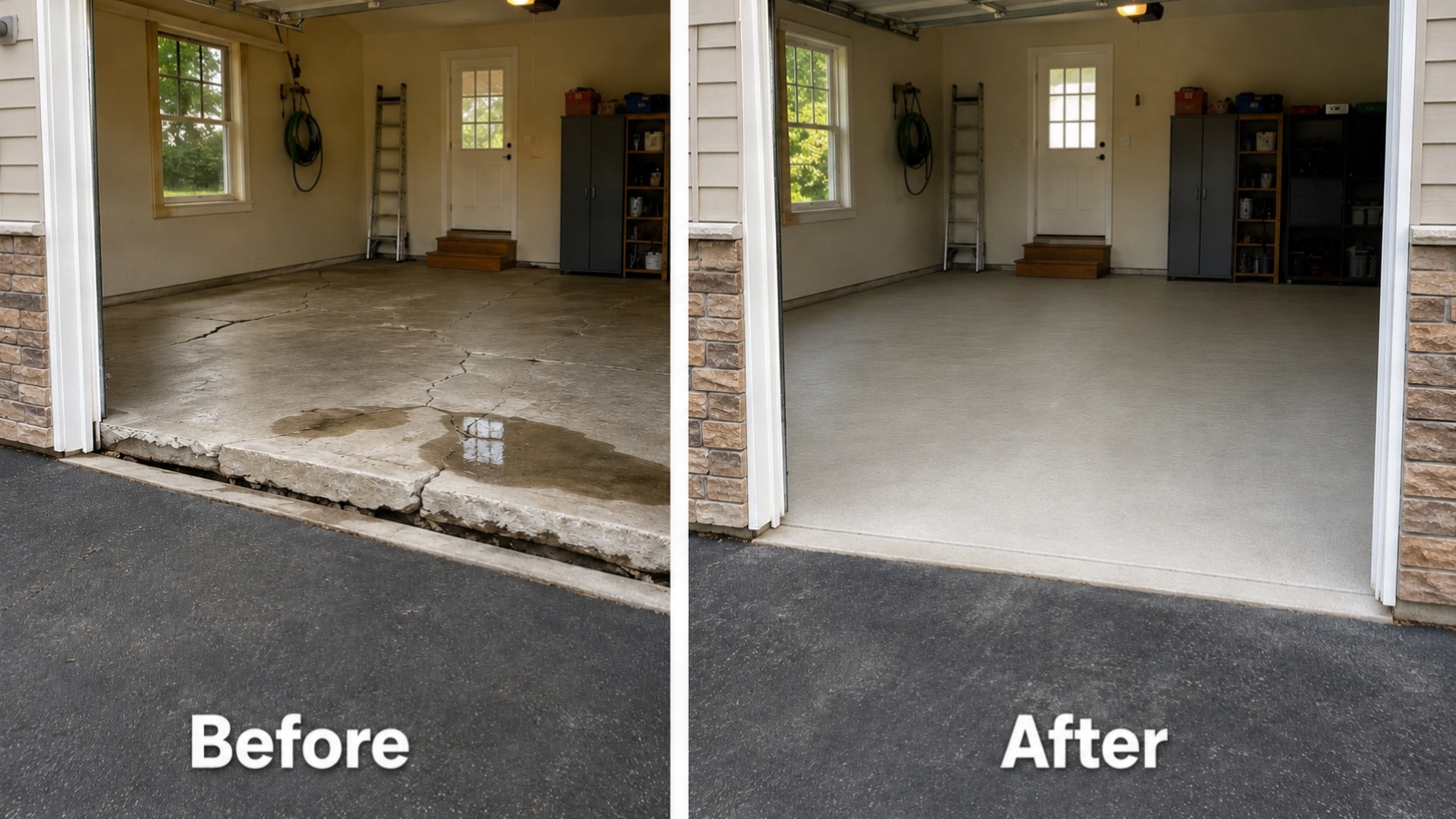
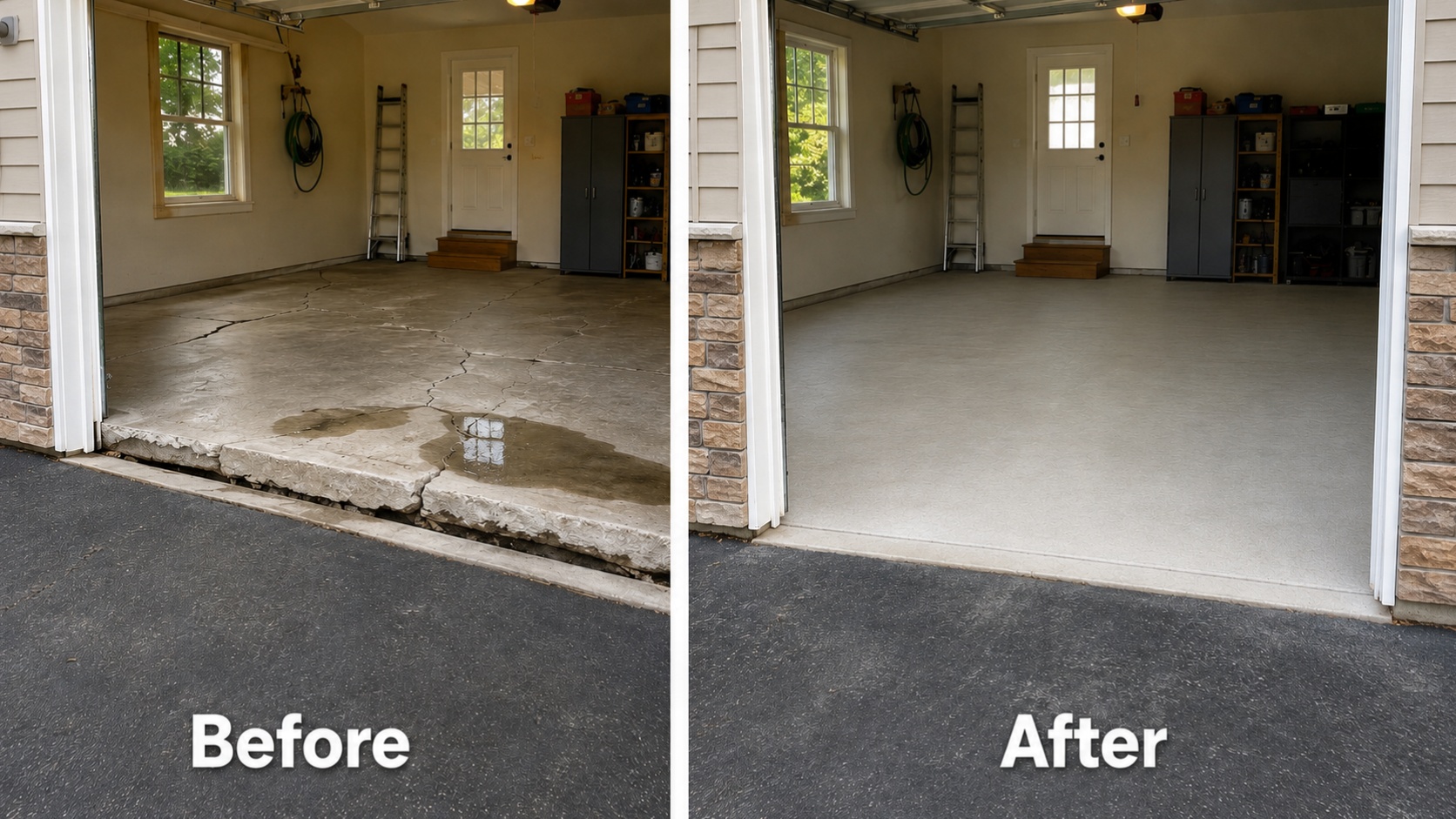
A sunken slab may need garage floor leveling and repair, while a surface crack or deteriorated area may call for a different concrete repair approach.
Below are five of the most common concrete floor problems we see in garages, what may be causing them, why you should care, and the repair options worth considering.
1. Sunken or Settled Garage Floor Sections
A garage floor does not always settle evenly.
Sometimes the entire slab drops slightly. More often, homeowners notice one corner, one side, or a section near the garage door sitting lower than the rest of the floor.
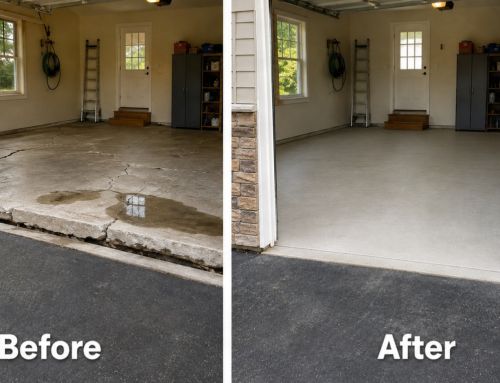
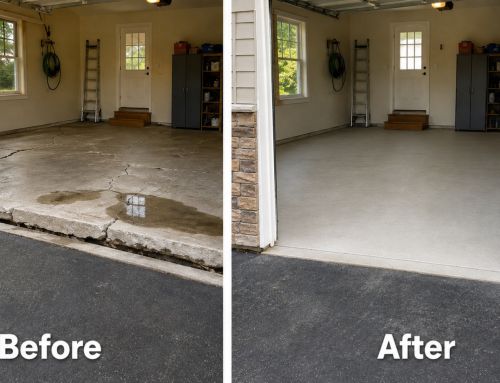
This is one of the garage floor problems we take most seriously because the concrete itself may still be perfectly usable. The problem may simply be that it has lost support underneath.
What Causes a Garage Floor to Sink?
The most common cause is movement in the soil or fill material beneath the concrete.
During construction, soil around a home is excavated, disturbed, and sometimes placed back around the structure. If the material beneath the garage slab was not compacted sufficiently, it can continue compressing over time.
As that soil settles, an empty space can form between the ground and the bottom of the concrete.
The slab above it may then begin to sink.
Water can create a similar problem.
A drainage issue near the garage, leaking water line, downspout discharge, or runoff entering beneath the slab can gradually wash away fine soil particles. The result is the same: less support underneath the garage floor.
Sometimes homeowners do not notice the movement for years.
Then a crack appears, water starts collecting, or one side of the garage suddenly feels lower.
Why Does Garage Floor Settlement Matter?
A settled garage floor can cause more than an uneven-looking surface.
It may create:
- Trip hazards
- Cracks with one side higher than the other
- Water collecting in low areas
- Problems at the garage door
- Uneven transitions between the driveway and garage
- Stress around steps or walls
- Difficulty installing finished flooring or coatings
The longer movement continues, the greater the chance that an otherwise solid slab begins cracking under uneven support.
That is why it is usually better to investigate settlement while the concrete is still in good enough condition to save.
What Can Be Done About a Sunken Garage Floor?
If the concrete itself remains strong, lifting may be a practical alternative to replacement.
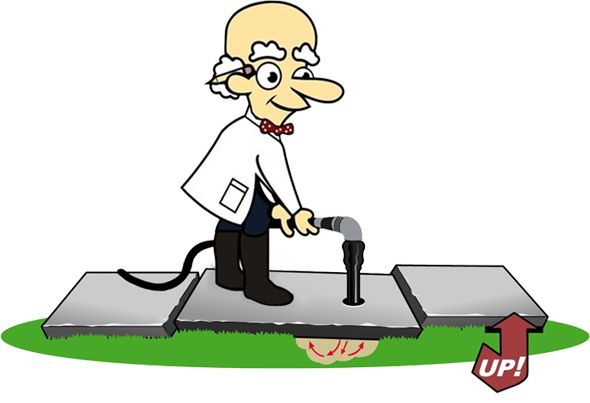
With professional concrete garage floor leveling, material is placed beneath the settled slab to fill voids and carefully raise the affected area.
We typically use traditional cement-based mudjacking, which involves drilling access holes through the slab and pumping grout beneath it.
The goal is not simply to push the floor upward.
We want to restore support beneath the concrete while correcting the settlement as much as conditions allow.
If you are seeing low spots, cracks with vertical displacement, or changes in floor elevation, our guide to the signs your garage floor may need concrete lifting can help you decide whether what you are seeing looks like settlement.
2. Cracks Across the Garage Floor
Cracks are probably the garage floor problem homeowners notice first.
But a crack by itself does not tell us exactly what is wrong.
Concrete naturally shrinks as it cures, and small flat cracks can develop without indicating serious movement.
The cracks that concern us more are the ones that change.
What Causes Garage Floor Cracks?
Garage floors can crack for several reasons.
Concrete shrinkage is one possibility. A lack of properly placed control joints can also encourage concrete to crack where stress builds up.
Other causes include:
- Soil settlement beneath the slab
- Voids developing under part of the floor
- Excessive loads
- Insufficient slab thickness for the application
- Ground movement
- Poor original installation
- Movement between adjoining sections of concrete
One useful clue is the height of the concrete on each side of the crack.
If both sides remain at roughly the same elevation, you may be looking at a relatively simple crack.
If one side has dropped below the other, settlement underneath the slab may be involved.
Why Do Garage Floor Cracks Matter?
Some homeowners ignore cracks because the car can still drive over them.
The problem is that cracks can change.
A widening crack may be telling you that movement is continuing. A crack with vertical displacement can become a trip hazard. Water and debris can also enter open cracks.
There is another practical issue.
If you plan to install an epoxy coating, tile, or another finished garage surface, unresolved slab movement can affect whatever you put on top.
Fixing the appearance without understanding the cause may leave you dealing with the same problem again.
How Should Cracked Garage Concrete Be Repaired?
The solution depends on why the crack formed.
For a stable surface crack without settlement, an appropriate flexible crack-repair material may be enough. You can read more about the different factors we consider on our concrete repair service page.
But if one side of the crack has sunk, filling the crack is not the complete repair.
In that situation, we first want to correct the slab movement.
A section that has dropped because of lost support may need concrete slab repair and leveling before cosmetic crack repair makes sense.
Think of the crack as a clue.
We do not want to hide the clue before understanding what caused it.
3. Water Pooling on the Garage Floor
You pull the car into the garage after heavy rain or snow and notice water collecting in one particular area.
Maybe it sits there for hours.
Or perhaps rainwater is making its way underneath the garage door and settling in a low section rather than draining back out.
A garage floor should have a useful pitch that helps water move in the intended direction. When that pitch changes, water problems often follow.
What Causes Water to Pool on Garage Concrete?
The first possibility is that the floor was originally poured with an inadequate slope.
But if water only started collecting recently, something may have changed.
Settlement is a common reason.
Imagine the floor originally sloping gently toward the garage entrance.
If the middle of the slab later drops, that area can become a shallow basin.
Water that once flowed out now collects there.
The problem can also be related to the concrete immediately outside the garage.
If the driveway or apron has settled, its relationship with the garage floor changes. Water may begin flowing toward the garage instead of away from it.
Poor exterior drainage can make matters worse by sending larger amounts of water toward the entrance.
Why Does Standing Water Matter?
A puddle may seem like a minor inconvenience until you are constantly sweeping or squeegeeing water out of the garage.
Standing water can also make the floor slippery.
It may keep stored items damp, contribute to staining, and make an already cracked or deteriorating floor more troublesome.
More importantly, recurring water can sometimes point to a larger drainage or settlement problem that should be corrected rather than managed with a mop.
If the pitch of the concrete has changed because a slab settled, the low spot itself needs attention.
What Are the Possible Solutions?
First, determine whether the floor’s elevation has actually changed.
If settlement has created the low area, garage floor leveling and repair may help restore a more useful elevation and pitch.
But we also look outside the garage.
If a driveway slab has sunk near the garage entrance and is directing water toward the door, correcting the exterior slab may be equally important. In that situation, our driveway leveling and repair service may be the more relevant solution.
The goal is not simply to get rid of today’s puddle.
It is to understand why water is collecting there and correct the concrete problem contributing to it.
4. An Uneven Transition Between the Garage Floor and Driveway
This problem is easy to recognize.
Every time you drive into the garage, you feel a bump.
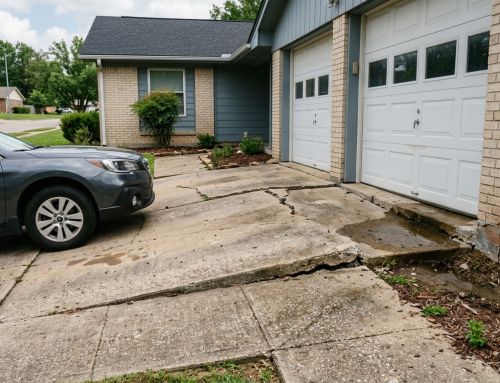
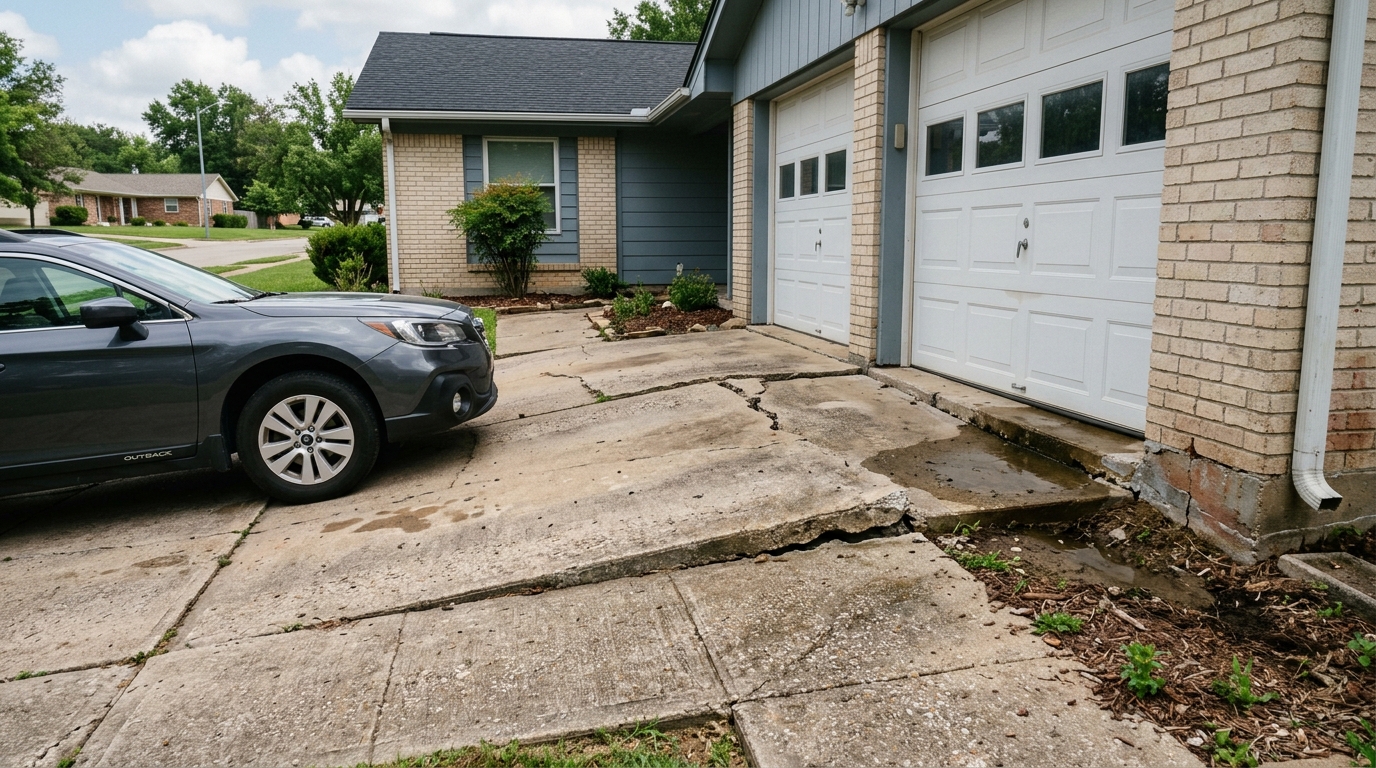
You may also notice a lip where the garage floor meets the driveway, a gap under the garage door, or one slab sitting noticeably higher than the other.
The difficult part is figuring out which piece of concrete actually moved.
What Causes the Garage-to-Driveway Height Difference?
Garage floors and driveways are separate concrete areas, and they do not always settle at the same rate.
The soil underneath an exterior driveway is exposed to different moisture and temperature conditions than the soil underneath the garage.
One slab may remain relatively stable while the other drops.
For example, the driveway slab closest to the garage may settle because of poorly compacted fill placed near the home during construction.
In another property, the garage floor itself may have dropped while the driveway remained in approximately its original position.
Water and poor drainage around the garage entrance can accelerate soil loss in either area.
Why Is an Uneven Garage Entrance a Problem?
A significant height difference can affect more than the comfort of driving into your garage.
It can create a walking trip hazard.
It may interfere with how the garage door seals at the bottom.
A low driveway slab can hold water near the garage entrance, while a low garage floor can allow water entering the space to travel farther inside.
Repeated vehicle impact across a sharp edge is another reason not to ignore a major transition problem.
We also see homeowners attempt to solve this by adding a small ramp or patching material along the edge.
That might soften the bump temporarily, but it does not correct a slab that has actually sunk.
How Can the Transition Be Fixed?
The first step is figuring out which slab is out of position.
If the garage floor is the settled section, we look at whether garage concrete leveling can bring it closer to the proper elevation.
If the exterior slab is the one that has dropped, the repair may fall under concrete driveway leveling.
There are also situations where more than one slab has moved.
That is why photos showing both the inside garage floor and the driveway outside are especially useful when you contact us.
We want to see the entire transition, not just the bump.
5. Spalling, Flaking, or Deteriorating Garage Concrete
Not every garage floor problem starts underneath the slab.
Sometimes the issue is the concrete surface itself.
You may notice small flakes breaking away, rough areas, shallow pits, scaling, or patches where the top layer of concrete appears to be deteriorating.
This is commonly called spalling or surface deterioration.
What Causes Garage Floor Surface Damage?
Concrete can deteriorate for several reasons.
The original concrete mix and finishing process matter. Too much water added during placement can weaken concrete. Poor finishing practices can also leave the top surface more vulnerable.
Exposure matters too.
Although your garage is covered, the floor still receives moisture, road salt, de-icing chemicals, vehicle traffic, dirt, and temperature changes carried in from outside.
During winter, your vehicle can bring salty snow and water directly onto the garage floor.
Over many seasons, a weak concrete surface can begin showing the effects.
There is also an important distinction between surface deterioration and settlement.
A garage slab can be perfectly level but have a failing surface.
Another floor can be badly settled while the surface remains strong.
Some have both problems.
Why Does Spalling Matter?
Minor surface wear may be mainly cosmetic.
More advanced deterioration can become increasingly difficult to maintain.
Loose concrete creates dust and debris. Pitted areas can hold water and dirt. Damage may also become much more visible if you were planning to clean, coat, or finish the garage floor.
The bigger question is how deep the deterioration goes.
A thin damaged surface is different from concrete that is weak throughout the slab.
That difference affects whether repair makes sense.
What Can Be Done With a Deteriorating Garage Floor?
For relatively shallow surface failure, specialized concrete repair or resurfacing products may sometimes be appropriate.
However, we do not recommend covering deteriorated concrete without first understanding why it failed.
If the damage extends deeply through the concrete or the slab has lost significant integrity, replacement may ultimately make more sense than repeatedly patching it.
Our concrete repair service explains more about how crack damage, settlement, and spalling require different approaches.
And if the surface damage is happening alongside a sinking section, we would evaluate the settlement separately before deciding whether the slab is still worth lifting.
Is It a Garage Floor Problem or a Foundation Problem?
This is something homeowners understandably worry about.
A sinking or cracked garage floor does not automatically mean your home’s foundation is failing.
Garage slabs can settle independently because they sit on soil or fill that moves while the structural walls remain stable.
But we also do not like making assumptions.
If garage-floor movement appears alongside major foundation-wall cracks, bowing walls, structural movement, or other problems throughout the house, the situation deserves a broader assessment.
Structural foundation concerns are different from ordinary slab settlement and require a different repair approach.
You can learn more about those issues through our basement and foundation repair service.
The important thing is to identify what has actually moved.
Should You Repair or Replace a Problem Garage Floor?
This is probably the biggest decision behind most garage-floor calls we receive.
Homeowners often assume that once concrete has cracked or sunk, demolition is inevitable.
That is not always true.
If the slab is still strong and the main problem is settlement underneath it, professional concrete leveling can often preserve the concrete you already have.
That means avoiding unnecessary demolition simply to correct an elevation problem.
On the other hand, if the concrete is extensively crumbling, badly fragmented, severely deteriorated, or unsuitable for lifting, replacement may be the better investment.
We do not believe every slab should be saved.
We believe a good slab should not be discarded simply because it moved.
That distinction can save a homeowner a great deal of unnecessary work.
What Should You Do When You Notice a Garage Floor Problem?
Start by looking at the whole area rather than focusing on one crack or puddle.
Ask yourself:
- Is any part of the floor visibly lower?
- Does one side of a crack sit higher than the other?
- Is water collecting where it did not collect before?
- Has the driveway-to-garage transition changed?
- Is the concrete itself breaking apart?
- Does the problem appear to be getting worse?
Then take clear pictures.
Include wide shots of the garage as well as close-ups of the areas concerning you. If the problem is near the garage door, include pictures of the driveway and entrance too.
At Concrete Chiropractor, homeowners can contact us and send clear images of the affected areas for an initial evaluation.
We review what you are seeing, explain where we believe the problem lies, and recommend the repair approach that makes sense.
If leveling is appropriate, we can then schedule the work and mobilize to your property.
Simple and practical.
Need Help With a Problem Garage Floor in NJ or Eastern PA?
Garage floor problems rarely come with labels telling you exactly what caused them.
A crack may be harmless shrinkage—or a sign of settlement.
A puddle may be a drainage inconvenience—or evidence that part of the slab has dropped.
A bump at the garage entrance may be coming from the floor, the driveway, or both.
You do not have to diagnose it yourself.
Concrete Chiropractor helps homeowners throughout New Jersey and Eastern Pennsylvania evaluate sunken, cracked, uneven, and damaged concrete and determine whether the existing slab can be repaired.
If your garage floor is sinking or uneven, start with our concrete garage floor leveling and repair service.
If you are not sure exactly which of these five problems you have, contact Concrete Chiropractor and send us clear photos of the affected area.
We will help you understand what is happening before you decide what to do next.

- Can You Fix a Settled Patio Without Replacing It? Repair in Ambler, PA - August 31, 2026
- How We Restore Sunken Garage Floors in South Plainfield, NJ - August 31, 2026
- Top 5 Concrete Floor Problems in Garages and Solutions - August 31, 2026