
IN THIS ARTICLE
Discover the root cause of a sinking driveway near your garage and how to fix it immediately.
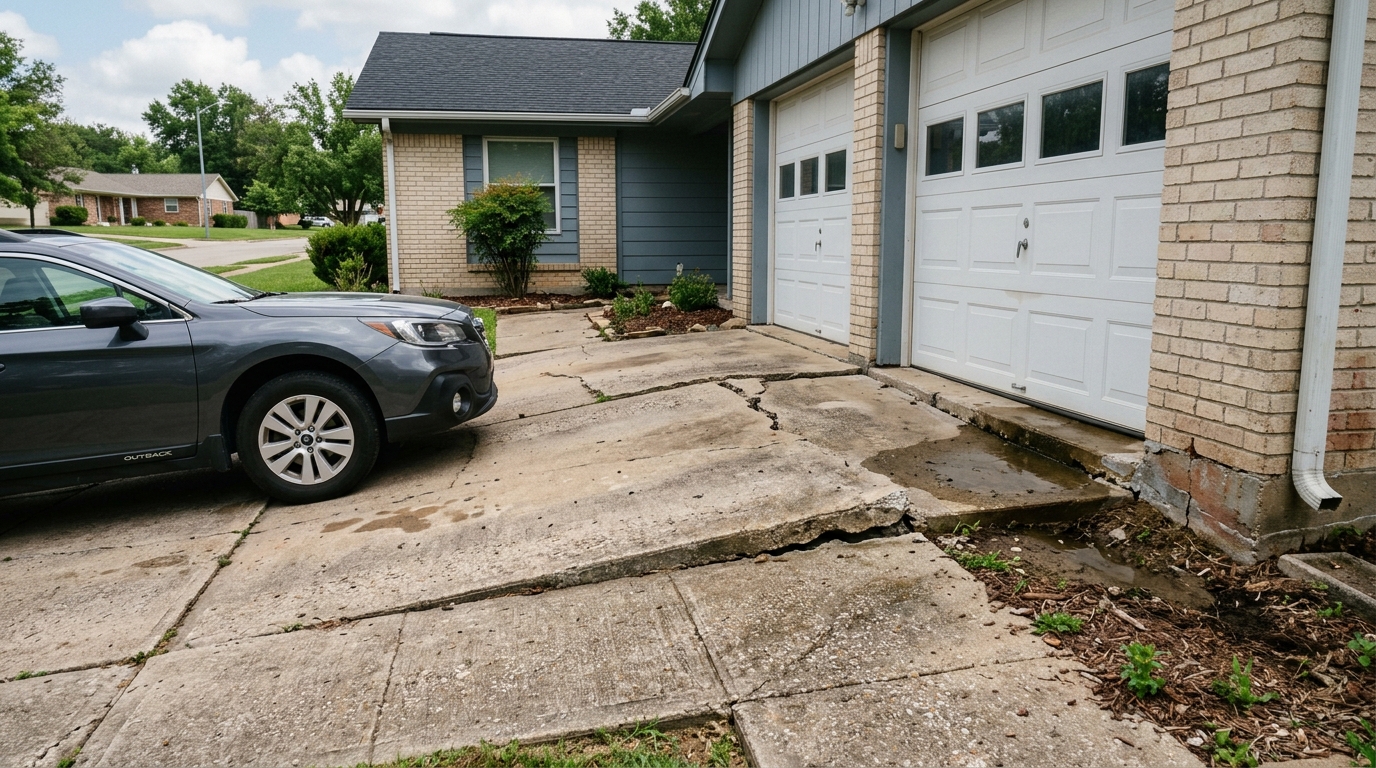
You pull into your driveway and notice something looks off. The concrete near the garage entrance is lower than it used to be. Maybe there’s a gap forming between the driveway and the garage floor, or water seems to collect right at the entrance after it rains. If this sounds familiar, you’re not alone. Sinking driveways near the garage is one of the most common concrete problems we see in homes across New Jersey and Eastern Pennsylvania.
The good news is that this problem has a clear cause, and it has a real fix.
Why Driveways Commonly Sink Near the Garage
The area right at your garage entrance takes more punishment than almost any other part of your driveway. Understanding why it sinks starts with understanding what that spot goes through every single day.
The garage area bears the most weight.
Every time you pull in or out, your vehicle rolls over that same section of concrete and comes to a stop in roughly the same spot. A typical passenger car weighs between 3,000 and 4,500 pounds. An SUV or truck can be significantly heavier. That load lands on the same small patch of concrete over and over, year after year. The ground beneath it eventually gives way.
Soil near foundations is often backfilled and less compacted.
When your home was originally built, the crew had to dig around the foundation to pour it. Once that work was done, they filled the excavated area back in. That backfilled soil is looser than undisturbed ground. It takes years to settle on its own, and in many cases, it never fully compacts the way natural soil does. The concrete slab on top of it has less support than it should.
Water tends to collect near the garage entrance.
The slope of your driveway is supposed to direct water away from your home. But over time, as the concrete shifts, water can start pooling near the garage instead of draining away from it. Standing water softens the soil beneath, which leads to more settling, which leads to more pooling. It becomes a cycle.
Repeated pressure causes gradual settling over time.
This is not the kind of problem that happens overnight. It builds slowly over months and years. The weight, the water, and the loose soil all work together to wear down the support beneath the slab until the concrete visibly drops.
This problem is more common than most homeowners expect. We hear people say they thought it was just their driveway, or that their house was too old, or that concrete just does this. The truth is it happens to driveways of all ages, in neighborhoods across the region. The conditions that cause it are almost built into the way homes are constructed.
The Most Common Causes of a Sinking Driveway
Knowing the general reasons why the garage area is vulnerable is one thing. But to actually fix the problem and keep it from coming back, you need to understand what specifically is happening beneath your slab. Here are the most common causes we find.
Poor soil compaction during construction.
As we mentioned, backfilled soil around foundations is rarely as dense as it needs to be. But poor compaction can happen under any part of a driveway if the prep work was rushed or done incorrectly. Loose soil compresses under load and leaves voids beneath the slab.
Water erosion washing away support beneath the slab.
Water is one of the most destructive forces your driveway faces. When rainwater or snowmelt seeps through cracks in the concrete or along the edges of the slab, it carries fine soil particles with it as it drains away. Over time, this erosion creates empty pockets underground. When those voids get large enough, the concrete above them sinks or cracks.
Drainage issues around the garage.
If your property does not drain water away from the garage area efficiently, that water sits and soaks into the ground. Downspouts that discharge too close to the driveway, clogged gutters, or grading that slopes toward the house all contribute to this. Poor drainage is one of the main reasons we see sinking driveways in homes that are only a few years old.
Freeze-thaw cycles expanding and contracting the ground.
New Jersey and Eastern Pennsylvania get cold winters. When water in the soil freezes, it expands. When it thaws, it contracts. That repeated movement shifts the soil and the concrete slab sitting on top of it. Year after year, freeze-thaw cycles loosen the ground and disrupt the support beneath your driveway.
Heavy vehicle traffic over time.
If multiple vehicles park on the same section of driveway, or if you regularly park trucks, vans, or larger vehicles, the cumulative load accelerates settling. The soil beneath simply was not designed to hold that much weight indefinitely without proper compaction and support.
Signs the Problem Is Getting Worse
A sinking driveway does not stay the same. If the underlying cause is not addressed, the damage will continue to grow. Here are the signs that tell you it is time to act.
Visible slope toward the garage.
Stand at the end of your driveway and look toward the garage. If the concrete appears to dip down near the entrance, the slab has already sunk. Even a small slope is a sign that the soil beneath has shifted.
Gaps forming between the driveway and the garage floor.
This is one of the clearest signs of sinking. When concrete settles unevenly, it pulls away from adjacent surfaces and leaves an open gap. That gap allows water, debris, and pests to get underneath the slab, which speeds up the damage.
Cracks in the concrete surface.
Concrete does not bend. When the ground beneath it shifts, the slab cracks. Small hairline cracks can grow into larger ones over time. Cracks also let water in, which makes the erosion problem worse.
Water pooling near the garage entrance.
If you notice a puddle forming in the same spot after every rain, that low point is telling you where the slab has sunk. Water that used to run off is now collecting because the slope has changed.
Uneven surfaces becoming a trip hazard.
A raised edge or a dip in the concrete is a real safety risk. It is easy to catch a foot on an uneven surface, especially in dim light or when carrying something. If visitors, family members, or elderly parents use your driveway, this is not something to put off.
How Mudjacking Fixes a Sinking Driveway
When a driveway sinks, the instinct for many homeowners is to replace the whole slab. But in most cases, that is not necessary. Mudjacking is a proven method that fixes the actual problem, at a fraction of the cost of replacement.
It lifts the concrete back to its original level.
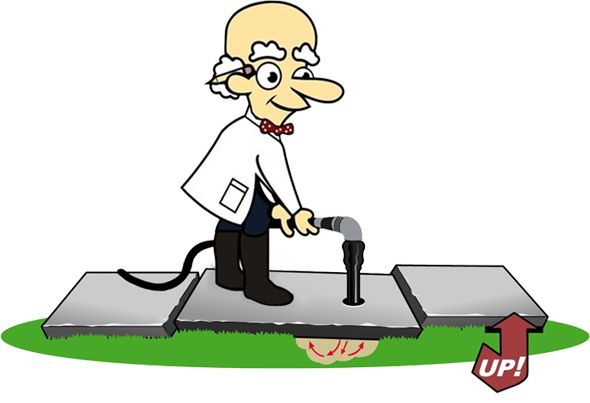
We drill small holes through the sunken slab and pump a dense grout mixture underneath. The pressure from that grout pushes the concrete upward until it sits level again. The work is precise, and we control the lift carefully to match the surrounding surfaces.
It fills voids beneath the slab with dense, natural grout.
The grout we use is a mixture of soil, water, and cement. It flows into empty spaces beneath the concrete and fills them completely. This is the part that actually addresses the root cause. You are not just propping the slab up temporarily. You are replacing the missing support.
It restores proper support and stability.
Once the voids are filled and the slab is lifted, the concrete has a solid base again. The grout sets firm and holds its position. The result is a stable slab that sits the way it was originally intended to sit.
It prevents further sinking when done correctly.
Because mudjacking fills the voids that caused the problem in the first place, it removes the conditions that led to the sinking. The grout does not wash away the way loose soil does. A properly done mudjacking job gives your driveway long-term stability.
It is faster and more cost-effective than replacement.
Tearing out and replacing a driveway slab is a major project. It takes time, it produces waste, and it costs significantly more. Mudjacking typically takes a few hours, and you can use your driveway again the same day. For a problem that can be fixed at the source, replacement is rarely the right first step.
We say it plainly to every homeowner we work with: fix the root cause, not just the surface. Patching cracks or pouring new concrete over a slab with voids beneath it will not hold. The problem will come back. Mudjacking fixes what is actually wrong.
Get a Free Concrete Floor Assessment
Not sure what is causing your driveway to sink? That is exactly why we offer a free concrete floor assessment. We take a look at a clear image of what is happening, and give you a straight answer about what is going on and what it will take to fix it.
Our team specializes in mudjacking solutions built to last. We have worked with homeowners across New Jersey and Eastern Pennsylvania, and we know the soil conditions, the drainage challenges, and the freeze-thaw patterns that affect concrete in this region.
We do not push you toward the most expensive option. We identify the root issue and recommend the right fix for your specific situation.
If your driveway is showing any of the signs we described above, do not wait for the problem to get worse. Contact Concrete Chiropractor today to schedule your free assessment and protect your driveway before the damage becomes a bigger job.

- Leveling Pool Decks & Patios in Ocean County Before Summer Starts - April 13, 2026
- The Best Concrete Lifting Services in Central Jersey, USA. - April 13, 2026
- Why Is My Driveway Sinking Near the Garage? - April 13, 2026