
IN THIS ARTICLE
Here’s why you need to level your Pool Decks & Patios in Ocean County Before Summer Starts
If you have a pool deck or patio that has started to sink or shift, now is the time to take care of it. Summer in Ocean County, New Jersey, comes fast, and once it does, your outdoor space will be seeing a lot of use. Getting the concrete leveled before the season kicks in makes everything easier, safer, and less stressful. In this article, we walk you through why timing matters, what causes these problems, and how we fix them.
Why Now Is the Best Time to Level Your Pool Deck or Patio
Spring is a short window, and it works in your favor. The ground has thawed, the wet season has done its damage, and summer is still weeks away. That gives us time to assess the problem, get the work done, and let everything settle before your family and guests spend weekends outside.
Preparing Your Outdoor Space Before Peak Summer Use
Pool decks and patios take a beating during summer. Foot traffic, water, and heat all put stress on concrete that is already dealing with uneven ground beneath it. If you wait until summer to address a sunken or cracked slab, you are dealing with the problem right when you need the space most. Fixing it now means your patio is ready on day one.
Avoiding Last-Minute Repairs When Demand Is High
Concrete leveling companies get busy as summer approaches. Homeowners across Ocean County and Eastern Pennsylvania all start noticing the same issues around the same time. If you call in June, you may be waiting. Scheduling your assessment and repair in spring means you get the work done on your timeline, not ours.
Safer Surfaces for Family, Kids, and Guests
Uneven concrete around a pool is a real hazard. People walk barefoot, kids run, and guests are moving around in wet conditions. A slab that is raised even half an inch is enough to catch a foot and cause a fall. Leveling the surface before the season starts removes that risk entirely.
Improving the Look of Your Home for Summer Gatherings
Cracked, sunken concrete does not look good. It makes a well-maintained yard look neglected, even if everything else is in great shape. When you level and restore your pool deck or patio, the surface looks clean and even again. It is a noticeable difference that makes your outdoor space a place you are proud to host.
Why Spring Is Ideal for Concrete Leveling in Ocean County, New Jersey.
In Ocean County, winters bring freeze-thaw cycles that shift the ground. By the time spring arrives, you can see exactly what that movement has done to your concrete. The soil is workable again, and conditions are right for the mudjacking process to perform well. Waiting too long into summer, when heat and dry spells set in, is not ideal. Spring is the sweet spot.
Common Problems with Uneven Pool Decks and Patios
Most homeowners notice something is off before they fully understand what is happening. Maybe the concrete looks a little tilted. Maybe there is a gap forming between slabs. These are signs of a real problem that tends to get worse over time if nothing is done about it.
Trip Hazards and Safety Risks Around Pools
A raised edge between two concrete slabs is one of the most common trip hazards in a backyard. Near a pool, that risk is higher because the surface is often wet and people are not always paying close attention to where they step. Even a small height difference can cause a serious fall. This is one of the main reasons homeowners call us.
Water Pooling and Drainage Issues
When concrete sinks, it changes the slope of your surface. Water that used to drain away from your home now pools in low spots. That standing water can sit against your foundation, seep under the slab, or create slippery patches that stay wet long after rain. Poor drainage is both a property damage issue and a safety issue.
Cracks and Sinking Concrete Slabs
Cracks in concrete are rarely just cosmetic. They usually mean the slab is moving or has lost support underneath. When the ground beneath a slab shifts or compresses, the concrete above it has to bear weight without proper support. That is when you see cracking, sinking at one edge, or the whole slab tilting. These problems do not fix themselves.
Damage Caused by Soil Movement and Moisture
Water is one of the biggest enemies of concrete in residential settings. When moisture moves through the soil beneath a slab, it carries particles with it. Over time, small voids form under the concrete. The slab sits on less and less material until it eventually shifts or sinks. Ocean County’s climate and soil type make this a common issue for homeowners here.
How Small Issues Become Bigger and More Expensive Over Time
A quarter-inch gap between slabs is manageable. A two-inch drop is a much bigger job. Concrete problems compound. The longer a void exists under a slab, the more the slab moves. The more it moves, the more it cracks. At some point, what could have been a straightforward leveling job becomes a full concrete replacement. Catching it early always saves money.
What Causes Concrete to Sink in Ocean County Homes
Understanding why concrete sinks helps you see why mudjacking is such an effective fix. The problem is almost always what is happening beneath the surface, not the concrete itself.
Sandy Soil Conditions Common in Ocean County
Much of Ocean County sits on sandy soil. Sandy soil drains quickly, which sounds like a good thing, but it also shifts easily. It does not hold compaction the way clay-heavy soil does. When concrete is poured over sandy soil, that soil can move, wash away, or settle unevenly over the years. This is a very common cause of sinking slabs in this area.
Water Erosion and Poor Drainage
Rainwater, sprinkler runoff, and pool water all make their way into the soil around your patio and pool deck. If drainage is not directing that water away from the slab, it works its way underneath. Over months and years, that water erodes the soil, creating voids that let the concrete shift downward.
Freeze-Thaw Cycles During Colder Months
Ocean County winters are not extreme, but temperatures do drop below freezing regularly. When water in the soil freezes, it expands. When it thaws, it contracts. This repeated movement pushes concrete up and lets it settle down in slightly different positions each time. After several winters, slabs that started level can be noticeably shifted.
Soil Compaction and Settling Over Time
When your home was built, the soil around it was disturbed during construction. That loosened soil takes years to fully settle. Concrete poured over soil that has not fully compacted will eventually sink as the ground beneath it continues to compress. Older homes, or homes where additions or landscaping changes were made, often see this kind of settling.
Heavy Use and Seasonal Weather Changes
Pool decks see consistent foot traffic, water exposure, and seasonal temperature swings. That combination adds stress to the soil and the slab over time. Heavy patio furniture, outdoor kitchens, or planters add weight that can accelerate settling in weaker areas. It is not one big event that causes most problems; it is years of steady stress adding up.
Why Mudjacking Is the Best Solution for Pool Decks and Patios
When homeowners discover their concrete has sunk or shifted, the first thought is often full replacement. That is rarely necessary, and it is almost always more expensive and disruptive. Mudjacking is a proven method that lifts and levels concrete by addressing the root cause: the void underneath it.
Lifts and Levels Concrete Without Replacement
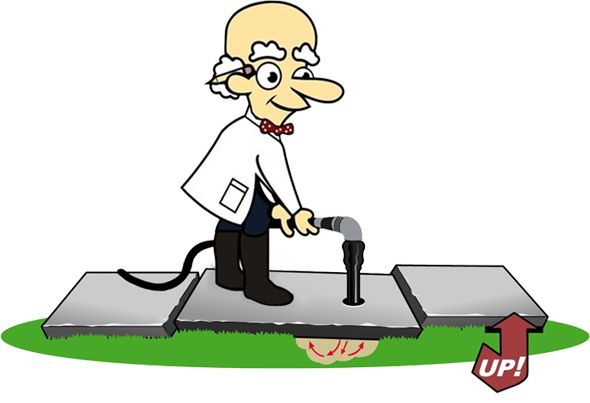
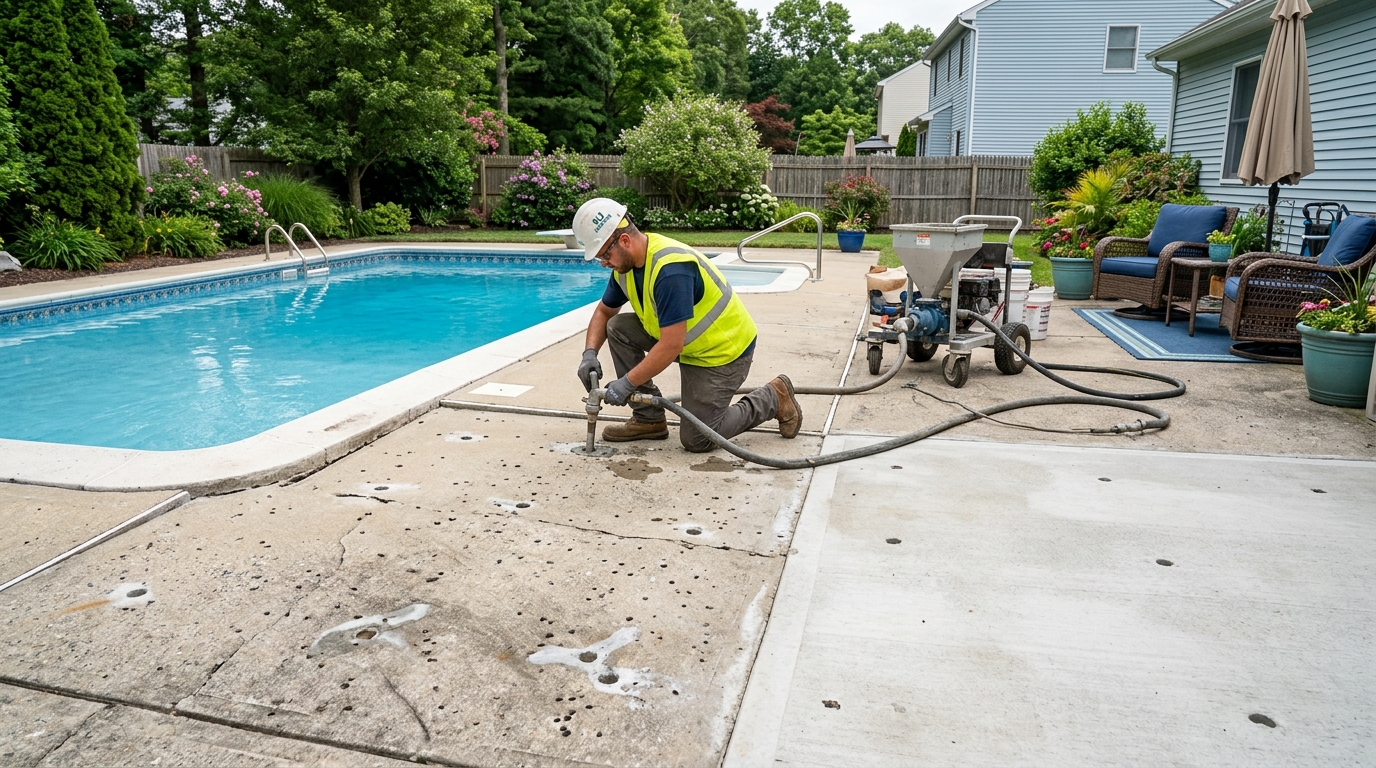
Mudjacking works by drilling small holes through the sunken slab and injecting a dense grout mixture beneath it. The pressure from that injection fills the void and pushes the slab back up to its original position. You keep your existing concrete. There is no demolition, no hauling away old material, and no waiting weeks for new concrete to cure.
Dense, Natural Grout Provides Long-Term Support
The material we use is a natural grout mix made from soil, water, and cement. It is dense, stable, and fills the void completely. Once it cures, it becomes a solid base that supports the slab the way the original ground should have. This is not a temporary patch. It is a long-term fix that addresses why the concrete sank in the first place.
More Stable Than Lightweight Foam Solutions
Polyurethane foam is sometimes offered as an alternative to mudjacking. Foam is lightweight, which can actually be a drawback in areas with sandy or unstable soil. It does not add the mass and density needed to hold a slab in place over time. Our grout-based approach gives the concrete real, lasting support that holds up through seasonal changes and regular use.
Quick Process with Minimal Disruption to Your Home
Most mudjacking jobs are completed in a single visit. The drill holes we make are small, typically around 1.5 inches in diameter, and we fill and smooth them after the job is done. You do not need to vacate your home, move heavy equipment to a different part of the yard, or deal with construction mess for days. The process is clean and efficient.
Eco-Friendly and Safe for Residential Environments
The grout mixture we use is made from natural materials. There are no chemicals being injected under your yard, no off-gassing, and nothing that poses a risk to your lawn, garden, or the area around your pool. It is a method that is well suited to residential environments where families, kids, and pets are present.
A long-term fix before summer, not a temporary patch.
Get a Free Concrete Floor Assessment in Ocean County
Not sure whether your pool deck or patio actually needs leveling? That is exactly the kind of question we help you answer. Many homeowners are not certain if what they are seeing is a serious issue or something minor. Our team will take a look and give you a straight answer.
We specialize in residential mudjacking for homeowners across Ocean County, New Jersey, and Eastern Pennsylvania. When we assess your concrete, we are not just looking at the surface. We are looking at what is happening underneath it. That is where the real problem lives, and that is what we fix.
We take the time to understand the root cause before we recommend anything. If mudjacking is the right solution for your situation, we will explain exactly what the process looks like and what you can expect. If it is not the right fit, we will tell you.
We serve industries and homeowners throughout Ocean County and know the soil conditions, weather patterns, and specific issues affecting concrete in this area. You get a team that understands your local environment, not a one-size-fits-all approach. Contact us today for your free concrete floor assessment and get your outdoor space ready for summer.

- Leveling Pool Decks & Patios in Ocean County Before Summer Starts - April 13, 2026
- The Best Concrete Lifting Services in Central Jersey, USA. - April 13, 2026
- Why Is My Driveway Sinking Near the Garage? - April 13, 2026