

IN THIS ARTICLE
Causes, Warning Signs & Repair Options For Concrete Floor Settlement in NJ Homes:
If part of the concrete floor inside your home has started sinking, sloping, or cracking, it is understandable to wonder what is happening underneath it—and whether the problem is going to get worse.
The good news is that a settled concrete floor does not always mean the concrete itself has failed. In many New Jersey homes, the real problem begins underneath the slab, where soil has settled, washed away, or left an empty space that can no longer properly support the concrete above it.
Over time, that loss of support can cause one section of the floor to drop lower than another. You may notice a small dip at first, an uneven transition between rooms, cracks that were not there before, or a floor that seems to slope toward one side.
We have worked with settled concrete for more than 25 years, and one thing homeowners should know is that replacing the entire floor is not always the first or best solution.
If the existing concrete is still in reasonably good condition, professional concrete floor leveling and repair may be able to restore support beneath the slab and bring the sunken section closer to its proper position.
Before deciding how to repair the floor, however, it helps to understand why concrete settlement happens in the first place.
What Is Concrete Floor Settlement?
Concrete floor settlement happens when the material supporting the bottom of a concrete slab can no longer hold it at its original elevation.
Most residential concrete floors are poured over a prepared base of soil, stone, or other compacted material. When everything beneath the slab remains stable, the concrete has uniform support.
Problems begin when that support changes.
The soil may compress. Water may wash small soil particles away. Fill material placed during construction may continue settling. In other situations, empty spaces or voids gradually form between the ground and the underside of the slab.
Once part of the floor loses support, the weight of the concrete can cause it to move downward.
Sometimes the slab settles almost evenly. More often, however, one area drops more than another. That is when homeowners begin noticing slopes, uneven surfaces, cracks, or changes around walls and doorways.
This is also why repairing only the visible crack does not necessarily solve the problem.
If there is still an empty space underneath the concrete, the source of the settlement is still there.
What Causes Concrete Floors to Settle in NJ Homes?
We often tell homeowners that the concrete they can see is only half of the story.
What is happening underneath the floor matters just as much.
Several conditions can contribute to concrete floor settlement in New Jersey homes.
1. Poorly Compacted Soil Beneath the Concrete
One of the most common causes of concrete floor settlement starts during construction.
Before a concrete floor is poured, the material underneath it needs to be properly prepared and compacted.
If loose fill is left beneath the slab, that material can continue compressing after the home has been built.
It may not happen immediately.
You could live in a house for years before noticing any obvious movement.
But as loose soil or fill gradually settles, the concrete above it can lose support. A small gap may form beneath the floor, allowing one section of the slab to sink.
This is one reason homeowners sometimes ask us why a concrete floor that seemed perfectly fine for years has suddenly become uneven.
The movement may not actually be sudden. It may have been developing slowly underneath the slab for quite some time.
2. Water Moving Beneath the Floor
Water is another major contributor to concrete settlement.
When water repeatedly reaches the soil beneath a slab, it can weaken the supporting material or carry small soil particles away.
Over time, this can leave empty spaces beneath the concrete.
The source could be a plumbing leak, drainage problem, groundwater movement, or water finding its way toward the house from outside.
You may never see a large washout underneath the floor. The process can happen gradually.
Eventually, however, one portion of the slab may no longer have the same support as the areas around it.
That is when a sinking concrete floor in the house may become noticeable.
If water is contributing to the problem, finding and correcting the water source is just as important as dealing with the settled slab.
3. Soil Erosion and Washout
Erosion is closely related to water movement, but it deserves special attention because even a small amount of soil loss can create problems over time.
Imagine water repeatedly traveling through the same area beneath or beside a concrete slab.
Little by little, fine soil particles can be carried away.
The concrete may still look normal from above while a void is developing underneath it.
Once that empty space becomes large enough, the slab may begin to drop.
This is why we do not like to look at a sunken floor and immediately assume the concrete is the only problem.
We also want to understand what caused the loss of support beneath it.
If the underlying problem continues, simply making the surface look better will not address the reason the settlement happened.
4. Changes in Soil Moisture
The ground around a New Jersey home does not remain in exactly the same condition throughout the year.
We deal with periods of heavy rain, snow, freezing temperatures, dry weather, and seasonal moisture changes.
Those weather changes alone do not mean your concrete floor will settle. A properly supported slab can remain stable for many years.
But when the soil underneath or around a home already has drainage, compaction, or erosion problems, changing moisture conditions can make those weaknesses more noticeable.
The real issue is whether the material supporting the concrete remains stable as conditions around the home change.
5. Unstable Material Beneath the Slab
Sometimes the problem is the material that was placed beneath the floor in the first place.
Organic material, construction debris, or poorly prepared fill can deteriorate or compress over time.
As that material changes, the slab above it loses support.
Again, this may take years to become obvious.
That is why concrete slab settlement in a New Jersey home can sometimes appear long after the original construction work was completed.
What Are the Warning Signs of Concrete Floor Settlement?
Some settled floors are easy to spot.
Others start with smaller changes that are easy to overlook.
If you are wondering whether your floor is actually settling, here are some of the warning signs we would pay attention to.
A Noticeable Low Spot in the Floor
A dip or sunken section is one of the clearest signs of concrete floor settlement.
You may feel the difference while walking across the room, or you may notice that furniture no longer sits level.
In more noticeable cases, a round object placed on the floor may consistently roll toward the same low area.
A floor that has always had a slight slope is different from one that appears to be changing.
If you know the surface was previously level and a low area is developing, it is worth having it looked at.
Cracks With One Side Lower Than the Other
Not every crack in concrete means the floor is settling.
Concrete can develop shrinkage cracks and minor surface cracks without significant movement underneath.
What gets our attention more quickly is a crack where one side of the concrete is noticeably lower than the other.
That vertical difference suggests that part of the slab has moved.
The larger the difference becomes, the more noticeable the floor may feel underfoot.
Gaps Around Walls, Steps, or Other Fixed Areas
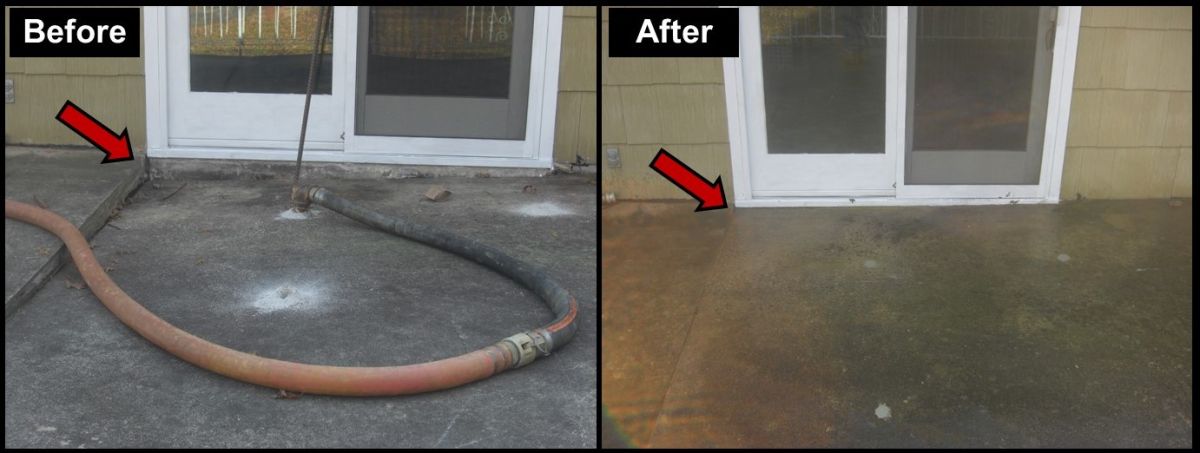
When a concrete floor moves downward while another part of the structure stays in place, small gaps can sometimes develop between them.
You might notice separation near a wall, step, threshold, support, or another fixed feature.
One small gap does not automatically tell us what caused the problem.
But when it appears alongside cracking or an obvious low area, it gives us another reason to investigate settlement.
Problems With Tile or Finished Flooring
Concrete settlement is not always visible because many interior slabs are covered.
Tile, laminate, vinyl, carpet, or another finished flooring material may hide the concrete underneath.
Sometimes the first warning sign is repeated tile cracking, flooring that begins separating, or a noticeable ridge or low spot.
If the slab underneath the finished floor has moved, replacing the flooring alone may not solve the problem.
You could end up installing a new surface over the same uneven concrete.
Water Collecting in a Low Area
Settlement can also change the way water drains across a floor.
This is especially noticeable on concrete surfaces that were designed with a slight pitch.
If your primary problem is a garage slab rather than another floor inside the home, we handle that separately through our garage floor leveling and repair service.
Garage floors often develop their own settlement patterns around door openings, walls, and areas exposed to vehicle loads and changing moisture conditions.
Does a Sinking Concrete Floor Mean Your Foundation Is Settling?
Not necessarily.
This is one of the biggest concerns homeowners have when they notice a floor dropping, so it is worth making the distinction clear.
Your concrete floor slab and the structural foundation supporting your house are not always the same thing.
It is possible for the soil directly underneath a floor slab to settle while the home’s main foundation remains stable.
In that situation, the floor may move without the entire house moving with it.
That is very different from structural foundation settlement.
At the same time, we do not recommend assuming every uneven floor is an isolated slab problem.
If you are also seeing significant foundation-wall movement, bowing basement walls, major structural cracking, or movement in several parts of the home, the issue may need a different type of evaluation.
Concrete Chiropractor addresses those concerns separately through our basement and foundation repair services.
The important point is simple: determine what is actually moving before deciding how it should be repaired.
Can a Settled Concrete Floor Be Repaired?
Yes, many settled concrete floors can be repaired without removing and replacing the entire slab.
This is usually possible when the concrete itself is still strong enough to be preserved and the main problem is the loss of support underneath it.
That is where concrete leveling comes in.
Our goal is to fill the empty space underneath the settled slab while carefully bringing the concrete closer to its proper elevation.
Concrete Chiropractor uses traditional cement-based mudjacking for concrete leveling.
The exact result depends on the condition of the slab, how far it has moved, accessibility, and what is located around it.
When we inspect a settled floor, we look at those factors before recommending a repair.
We would rather tell you what actually makes sense for the existing concrete than recommend lifting simply because the floor is uneven.
How Do We Repair a Settled Concrete Floor?
For floors that are good candidates for leveling, the process is fairly straightforward.
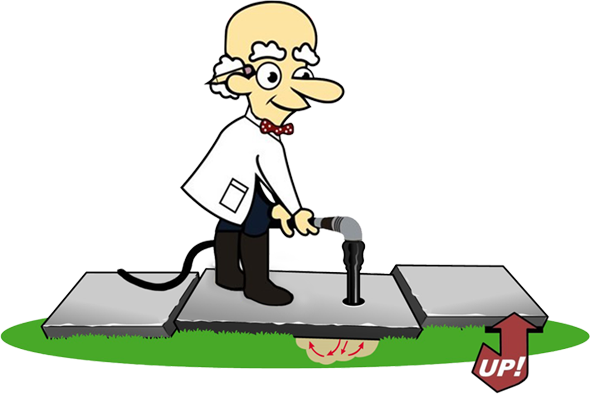
Small access holes are drilled through the existing concrete in strategic locations.
We then pump a cement-based grout mixture underneath the slab.
The material moves into empty spaces beneath the concrete and begins restoring the support that was lost.
As the void fills, controlled pressure can gradually lift the settled section.
Once the floor has been adjusted as much as conditions reasonably allow, the access holes are patched.
One of the biggest advantages of this approach is that you keep the existing concrete.
Instead of immediately tearing out a large section of floor, hauling the material away, preparing a new base, and pouring new concrete, we may be able to work with the slab that is already there.
For the right situation, that can make the repair far less disruptive.
What If Only One Concrete Slab Has Settled?
Sometimes the problem is much more localized.
You may have one slab section that has dropped while the surrounding concrete remains relatively stable.
In situations like that, the problem may be better addressed as a concrete slab repair rather than treating the entire floor as one large settlement issue.
Again, the condition of the concrete matters.
A solid slab that has lost soil support is very different from concrete that has badly deteriorated, crumbled, or broken into multiple pieces.
That distinction helps us determine whether preserving and lifting the existing slab makes sense.
When Is Concrete Replacement the Better Option?
We believe in saving existing concrete when it makes sense.
But we also know that not every slab should be lifted.
If a floor is severely deteriorated, badly fragmented, crumbling, or extensively damaged, raising it will not make weak concrete strong again.
In those situations, replacement may be the more practical long-term option.
The same may be true when the original slab has major construction problems that cannot reasonably be corrected through leveling.
That is why we look beyond the fact that a floor has sunk.
The more useful question is:
Is this concrete still in good enough condition to save?
If the answer is yes, leveling may be worth considering.
If the answer is no, replacing the damaged concrete may give you a better result.
Will Filling the Cracks Stop the Floor From Settling?
If the floor is still moving, usually not.
Crack fillers and surface repairs can make concrete look better, and they have their place.
But they do not restore missing support underneath the slab.
If there is a void beneath the floor, repairing the crack on top does nothing to fill that empty space.
The slab can continue moving, causing the same crack to reopen or another crack to appear nearby.
That is why we prefer to understand what caused the movement before focusing only on cosmetic repairs.
Sometimes the crack is the problem.
Other times, it is simply telling you that something underneath the concrete has changed.
How Serious Is Your Concrete Floor Settlement?
The best place to start is by paying attention to change.
Has the floor always looked this way?
Is the low spot becoming more noticeable?
Are cracks getting wider?
Has one side of a crack dropped below the other?
Are finished floors separating or tiles cracking repeatedly?
If the answer to any of those questions is yes, an evaluation can help you understand what is happening.
You do not have to diagnose the exact cause yourself.
Several different conditions can create similar symptoms, and what looks like a simple crack from above may involve a void underneath the slab.
Our job is to look at the concrete, understand how it has moved, and determine whether leveling is an appropriate solution.
Can You Prevent Concrete Floor Settlement From Getting Worse?
You cannot go back and change how the soil underneath an existing house was originally prepared.
But you can address some of the conditions that contribute to continued settlement.
Water management is one of the most important.
Make sure gutters and downspouts are moving water away from the home rather than dumping it beside the structure.
Watch for areas where water repeatedly collects.
If you suspect a plumbing leak near or beneath a slab, deal with it promptly.
Also take a look at exterior concrete around your home.
A settled walkway, patio, driveway, or other slab that slopes toward the house can send water in a direction you do not want it to go.
Correcting those drainage problems may help protect the soil supporting concrete around the property.
The goal is not to eliminate moisture from the ground.
That would be impossible.
The goal is to prevent concentrated water from repeatedly washing away or weakening the soil that supports your concrete.
Should You Repair a Sinking Concrete Floor Early?
You do not need to panic over every small crack or slight floor variation.
But settlement does not normally correct itself.
If a void continues getting larger or the soil underneath the slab keeps moving, a small low spot can become more noticeable over time.
The concrete may also begin cracking as unsupported sections are placed under additional stress.
Looking at the problem earlier gives you a better understanding of your options.
If the slab is still in good condition, there may be an opportunity to preserve and level it before the concrete becomes badly damaged.
Waiting until the floor is heavily fractured can make repair more complicated and may eventually leave replacement as the better option.
What Should You Do If Your Concrete Floor Is Sinking?
Start by looking closely at the affected area.
Notice where the floor is low, whether there are cracks, and whether one side of a crack sits lower than the other.
Think about nearby water sources or drainage problems that could be contributing to the movement.
Then look at the rest of the home.
Does the issue appear limited to the floor slab, or are you seeing other signs that suggest broader structural movement?
Most importantly, do not assume that a sinking floor automatically has to be torn out.
If the existing slab is still strong, it may be possible to restore support underneath it and raise the settled area.
That is exactly why an inspection is useful.
Need Help With Concrete Floor Settlement in Your NJ Home?
Finding a sinking or uneven concrete floor inside your home can be worrying, but it does not automatically mean you are facing a complete floor replacement.
In many cases, the concrete itself is still usable. The problem is the support underneath it.
At Concrete Chiropractor, we have more than 25 years of experience working with settled concrete throughout New Jersey. We use traditional cement-based mudjacking to fill voids beneath suitable slabs and carefully lift areas that have dropped.
We will first look at what caused the settlement, how much the floor has moved, and whether the existing concrete is in good enough condition to save.
If lifting makes sense, we will explain your options.
And if the concrete needs a different approach, we will tell you that too.
If you have noticed a low spot, uneven surface, cracking with vertical movement, or another sign of concrete floor settlement in your NJ home, learn more about our concrete floor leveling and repair services or contact Concrete Chiropractor to have the area evaluated.

- Can You Fix a Sunken Patio Without Replacing It? Patio Repair in Marlton, NJ - November 2, 2026
- Concrete Floor Settlement in NJ Homes: Causes, Warning Signs & Repair Options - November 2, 2026
- Can You Fix a Settled Patio Without Replacing It? Repair in Ambler, PA - August 31, 2026




Get Social